





Black Sunday in Guadalajara
Guadalajara’s clean water crisis boiled over this weekend after riot police armed with tear gas, stun grenades, and water canons confronted thousands of demonstrators gathered outside the governor’s mansion to protest the privatization efforts by the state.
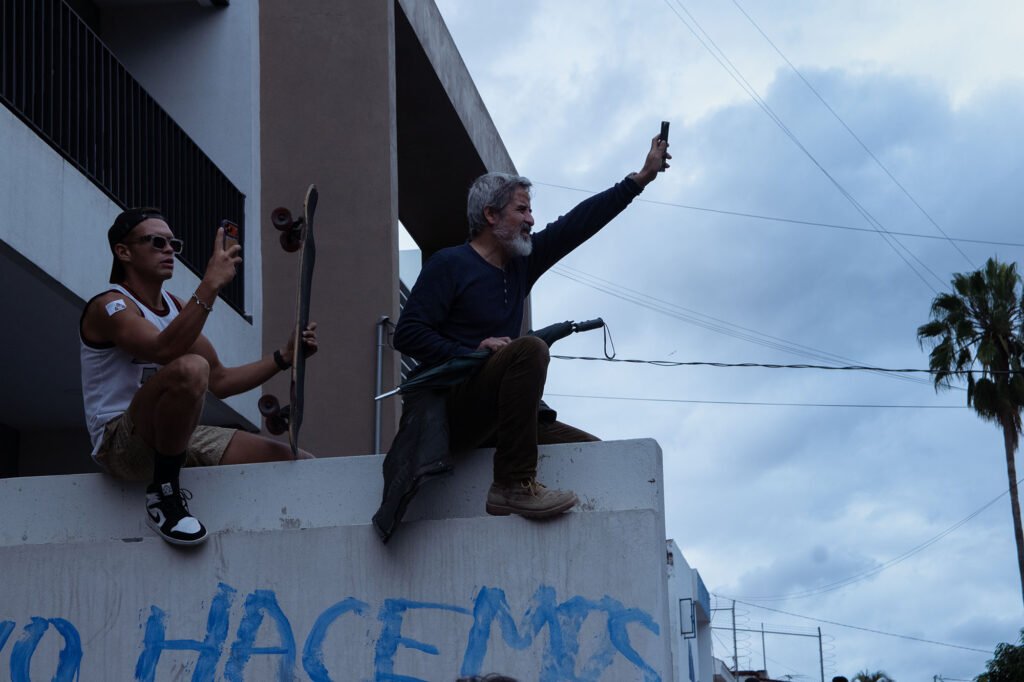
At least 10,000 people turned up to protest Guadalajara’s ongoing clean water crisis on Sunday in a planned march to the state governor’s mansion, Casa Jalisco. Upon arrival, demonstrators found steel barricades and local police forces blocking their access to the immediate vicinity of the official residence, which triggered the first confrontations. After breaching the first perimeter, protestors advanced towards the building, where hundreds of state police in riot gear surrounded the premises. Behind them, municipal fire firefighters awaited orders to turn on their hoses and several plain-clothes policemen collected rocks from the hedges around the mansion.
Tensions simmered as a group of activists stood inches away from the wall of riot shields, and masked provocateurs launched objects at police. Iván Becerra, a young university student, noticed one of the ranking officers standing on the other side give an order to another officer next to him, and alerted the crowd, raising his hand in the air and shouting “They want to attack!”. Becerra then pointed at the uniformed officer and warned him not to, when an arm reached through the thermoplastic shield wall and pulled the young man behind police lines. As four cops dragged Becerra away, fellow activists recriminated their actions and exhorted them to let him go.
Within seconds, several more activists were forcibly abducted from the crowd and all hell broke loose as the fire hoses started soaking demonstrators and tear gas canisters rained down on the masses. Less than half a mile away, the flash bangs could be heard by churchgoers in Holy Cross Parish during Sunday noon mass. “The government of Jalisco is in the wrong”, said former representative, Oscar Herrera Estrada, who retired from politics in 2021. “People are outraged and have every right to be upset”, he stated, and warned that repressive tactics like these would only exacerbate the problem.
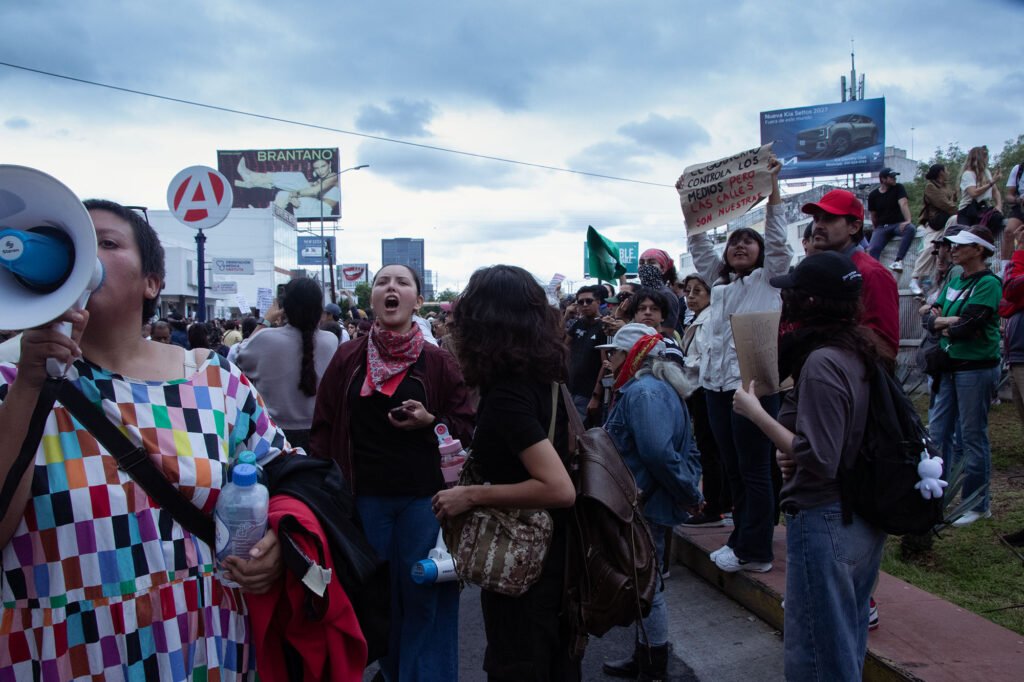
At issue is the absolutely putrid water coming out of the taps in homes all over the city. Millions of residents in Mexico’s second largest metropolitan area have been unable to use the water coming out of their faucets for the better part of three months or longer, forcing many to buy water by the jug to bathe, wash dishes, and do the laundry. An expense most cannot afford, while still required to pay their monthly water bill. Civil society groups began organizing as early as last spring to demand action from leaders and pertinent agencies, like the Intermunicipal Potable Water and Sewage System (SIAPA), which manages the water delivery infrastructure.
Rather than alleging incompetence or negligence, protesters have accused the state of directly sabotaging the potable water system, in order to justify the governor’s privatization plan. Jalisco governor Pablo Lemus announced the de facto privatization of SIAPA just before the end of the World Cup in July, carefully hidden under a state financing scheme. This past August, citizen groups and other organizations led another, much smaller protest march through downtown Guadalajara, carrying plastic bottles full of the brown, and sometimes black, water they brought from home, on their way to issuing a joint statement rejecting any privatization scheme and calling for the immediate restoration of potable water service. University of Guadalajara (UdG) researcher and hydrology expert, Arturo Gleason, broke down the governor’s proposal for the crowd, exposing it as a $2.2 billion boondoggle comprising 32 separate projects for private contractors to bid on, without any clarification on what problem each one intends to solve, who will execute it, who will operate it, and who will benefit from it.
“Water is a human right and shouldn’t be privatized”, Herrera stresses, adding that “every government should have the capacity to provide basic resources like water” to its people and any government that chooses not to or is incapable of doing so “definitely loses the ability to govern, and should resign”. With Mexico’s midterm elections rapidly approaching in June of next year, Pablo Lemus might find himself losing the slim majority his party, Movimiento Ciudadano (MC), now enjoys in the state legislature, if he is not forced out of office before then as a result of the clean water crisis.
MC’s opposition has pounced on the issue, and Sunday’s repressive actions have only emboldened them to rip into Lemus, who’s never been especially popular. His willingness to hand over public infrastructure projects to the private sector was proven last April, when he delivered Guadalajara’s public transportation fare system to a highly dubious fintech, with ties to Trump-adjacent tech oligarchs from Silicon Valley. Mexico’s ruling party, Morena, is already exploiting the governor’s ill-advised counter-protest measures against him, and some suspect that Sunday’s march was itself organized by Morena operatives.
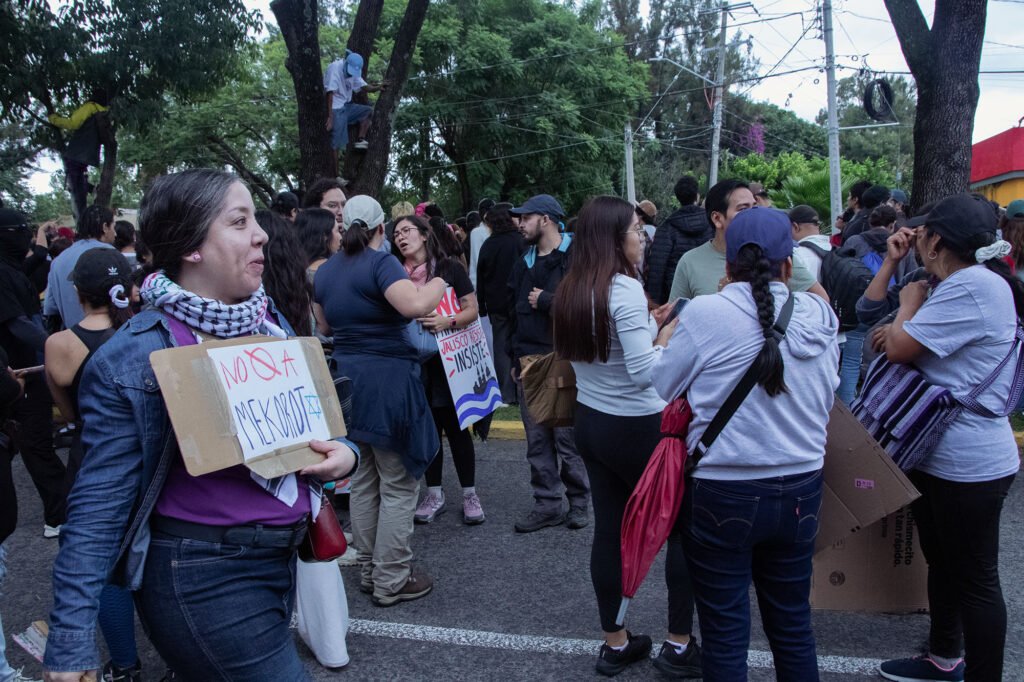
Another conspiracy theory that has gained a lot of traction, even within the grassroots movement in Guadalajara, is the notion that Pablo Lemus and the government of Jalisco is planning to give the city’s water infrastructure projects to Israeli companies, like Mekorot. A claim that has captured the imagination of many local activists, who largely identify with the Palestinian cause, not to mention social media, where the rumor is reported as fact. However, there is no concrete evidence to suggest that Mekorot or any other Israeli company is involved at this point.
Nevertheless, Jalisco did establish a relationship with Israel’s Institute of Technology, a.k.a. Technion, back in 2016 to work together on the development of a comprehensive water management system among other projects. A delegation that included the state’s then governor, his secretary of economic development, and the director of Jalisco’s Science, Innovation, and Technology (SICyT) agency, visited Israel to expand on a bilateral collaboration initiative that had begun three years before, when former Israeli Prime Minister Shimon Peres came to Mexico on a massive trade mission, looking to strengthen commercial ties between the two countries.
During the reciprocal visit, Jalisco’s governor signed a letter of intent (LOI) with Technion and reached at least three more agreements with YISSUM, the tech transfer and IP company inside Hebrew University, to exploit Israeli patents in Jalisco, adopt the University’s academic incentive programs in the state’s own higher education system, and a startup founder exchange program of sorts for Mexican founders. Exactly where these agreements stand ten years later, is difficult to know. But, Jalisco’s government isn’t the only actor in Guadalajara’s clean water saga with concerning links to the genocidal state of Israel. Morena senator Arturo Ávila Anaya, one of the main supporters of the party’s opportunistic campaign against Pablo Lemus, is deeply connected to the Israeli war machine through his own personal arms and surveillance businesses, as we covered in a recent article.
Ultimately, the solution to Guadalajara’s water crisis doesn’t depend on private investment. More than anything, it depends on enforcement of existing anti-pollution laws, and a good-faith collaborative effort between state and federal governments to allocate enough resources for the upkeep of shared water sanitation and distribution infrastructure, as well as the environmental protection of vital reservoirs.
“There’s an existing law”, Herrera mentions by way of example, “that requires manufacturing and agricultural industries to recycle the water they use, But, that law isn’t enforced.” In other words, every industrial plant in the country, whether they’re making widgets or sausage links, is supposed to have its own water treatment facility. Corruption allows the law to be ignored, and has led to catastrophic contamination of the water table, and higher levels of toxicity in the water before it even comes out of the ground. At a municipal level, waste disposal regulations for big developers in a city like Guadalajara are also routinely ignored with impunity, resulting in sewage getting dumped straight into rivers that connect to potable treatment plants, which are not equipped to handle waste water.
“We have many technological and biotechnological ways to purify water”, Herrera says, but he insists that “what is necessary and hasn’t been done, is to avoid polluting the water” in the first place. During his time in Jalisco’s congress as a member of the progressive Partido del Trabajo (Labor Party), Herrera sponsored a resolution calling for then governor, Enrique Alfaro, to declare a public health emergency over the rising pollution levels of the Santiago River, which is one of the primary sources of potable water for six states, including Jalisco. Although the measure was passed, Alfaro never declared the emergency, which would have pooled the collective resources of the states that depend on the river to deal with the problem at the point of origin.
Guadalajara has been through this before. Neoliberal politicians tried to privatize the system in the late 1980s, but failed to abscond with the vital resource to benefit a few fat cats thanks to popular opposition. Almost 40 years later, they’re back with their old tricks. The events that transpired on Sunday had echos of the 1968 massacre in Tlatelolco, one of most shameful tragedies in Mexican history. Lemus invoked the ghost of president Gusatvo Diaz Ordaz just days after the 58h anniversary of that murderous act of repression by unleashing his own goons to try to crush the will of the people. Fortunately, the only thing that died yesterday was his ability to govern.
There has never been a more critical time to support independent media
RDMPRESS relies on your support to produce independent journalistic content. Please consider making a donation today.