


Tortured Victory
Guadalajara’s citizens achieve tenuous victory in the battle for clean water amid torture, forcible disappearances, and agent provocateurs torching Jalisco’s state capitol, as the governor relents on privatization.
Mexico’s national human rights council (CNDH) has determined that elements within Jalisco’s state police coordinated with infiltrators to incite violence during the mass protests of October 11, when tens of thousands turned up to the governor’s mansion to demand a solution to the severe public health crisis caused by heavily contaminated water, that ended with the arrest of 39 people – unofficial reports place the number of forcibly detained citizens as high as 59 –, and allegations of torture at the hands of police.
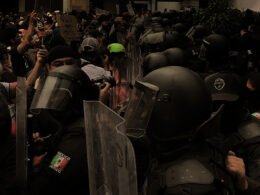
In a statement published by the federal entity on X this Monday, the CNDH confirmed that the agent provocateurs were coordinating directly with law enforcement, despite official claims to the contrary. Multiple videos recorded by demonstrators that day show masked men among the crowd of student activists and regular citizens, launching rocks and other projectiles at riot police surrounding the governor’s mansion. In one video, a masked individual is seen throwing an object just before one of the officers reaches through the riot shields to grab one of the protestors, and pull him in behind the police line.
Iván Becerra, the university student abducted in the video, was among the dozens of protestors snatched by police and sequestered inside the governor’s mansion, where they were held for hours. According to defense attorney Alejandra Cartagena, who is representing six of the demonstrators charged by the state, they were beaten and threatened while in police custody. Many had their IDs taken and their cellphones destroyed.
Alejandra Rivas, a 35-year-old mother who had attended the rally with her young daughter, recounted her harrowing experience as she was dragged by three female officers into a room in the official residence with her pants down, and beaten with batons. “I kept my head down, trying to protect myself”, as they shouted “obscenities at me, calling me a whore, and this and that.” Her shock and disbelief only grew when personnel from the CNDH’s Jalisco chapter (CNDHJ) refused to take her testimony of events and requested only her name, phone number, and address. “I wanted to tell them about what I had just gone through. But they only wanted my personal information”, she told La Jornada, stunned by their lack of empathy.
Jalisco’s CNDH was accused of stonewalling by the federal division of the human rights watchdog in Monday’s statement, highlighting its failure to submit their report as required by law. CNDHJ’s director, Luz del Carmen Godínez, is a crony of former governor Enrique Alfaro, who appointed her to the post despite having no qualifications and against the protestations of the organization’s own citizen council, which deemed the move as a blatant attempt to place the CNDHJ at the mercy of the state’s executive branch.
32 of the 39 detained on October 11 were released later that night or the following day, as pressure mounted on governor Lemus to answer for the repressive tactics. President Claudia Sheinbaum drew attention to the situation in her daily press briefings, and called for the CNDH to open the now ongoing investigation into the matter. Over the next 48 hours, the rest of the activists were let go, but with charges. In the meantime, a new protest march was organized for this past Sunday, October 18, to call for the governor’s resignation in addition to the people’s demands for clean water and a stop to the plans for privatization of the potable water system.
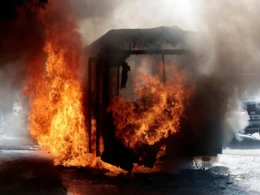
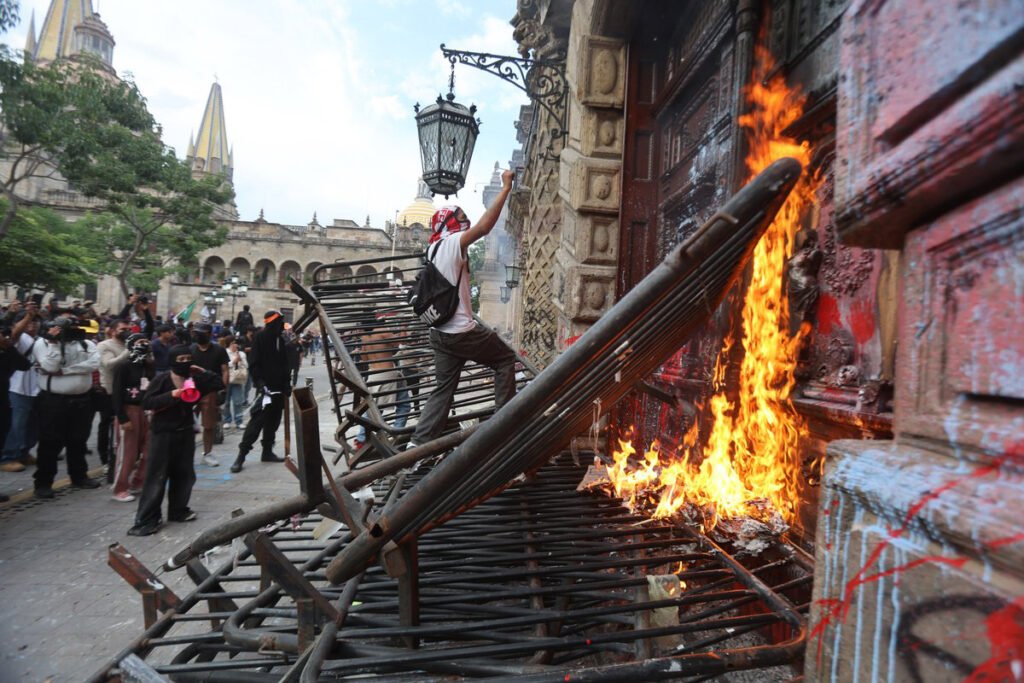
Before the second march could get fully underway, groups of masked infiltrators started arriving aboard pick up trucks and armed with hammers, baseball bats, spray paint and gasoline. Confronted almost immediately by peaceful protesters, the agitators were asked to leave and were pointed out to members of the relatively slim police presence, who nonetheless did very little. As the provocateurs were forced back, they turned on the protesters themselves and began throwing Molotov cocktails and rocks at them. Needless to say, the real demonstrators dispersed as a mob of face-covered rabble-rousers moved down Juarez shattering windows of businesses on their way to the state capitol building in downtown Guadalajara.
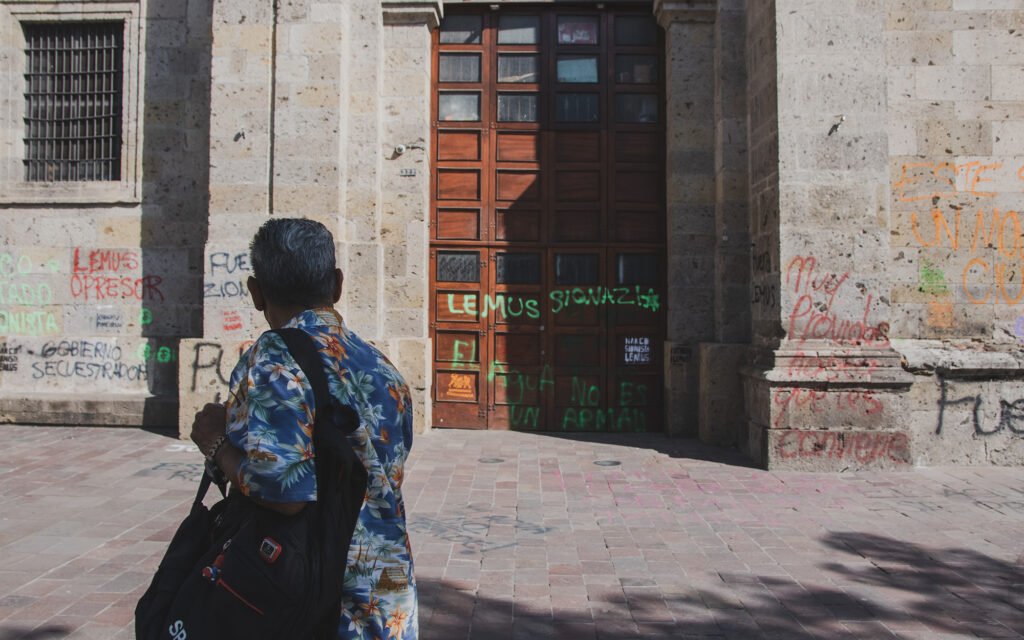
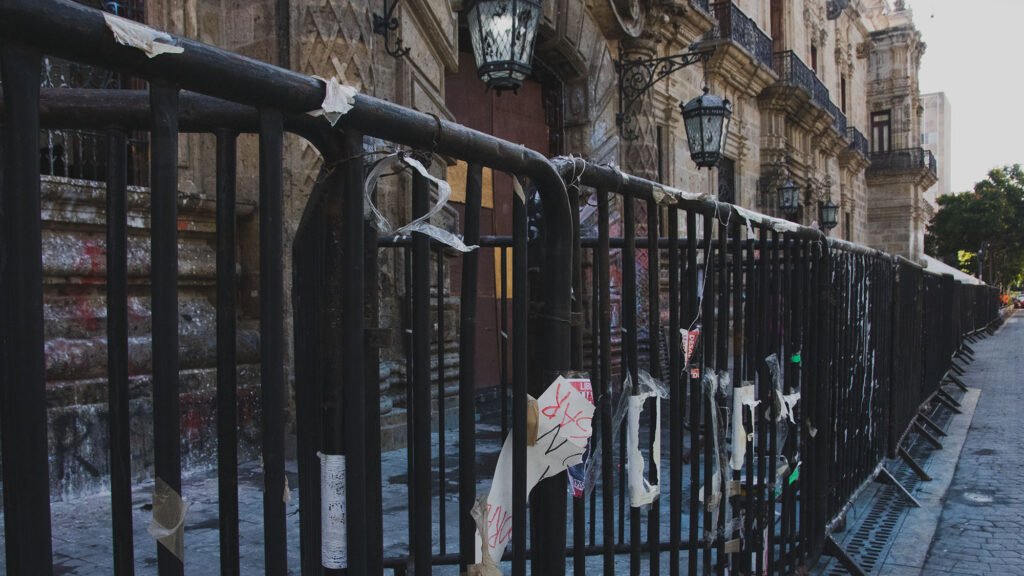
For the next nine and a half hours, the horde of infiltrators defaced the 236-year-old structure, broke multiple stained glass windows, and destroyed the large palace doors, breaching the main entrance and firebombing the foyer with incendiary bottles. The police mostly watched and only 10 arrests were made in all. In a press conference following the violent incidents, Jalisco’s secretary of public security, Juan Pablo Hernández González, claimed that there was a “reasonable suspicion” that the groups involved came from outside of the state, and that his agency was already working with homologous agencies across the country to identify them.
In a markedly different tone from a week ago, Lemus classified last Sunday’s protest as a “civic exercise by the citizenry” that was able to resist the provocations of a few “violent elements”, and tried to distance himself from the repression of the previous Sunday by asserting that “this time, neither citizens nor law enforcement fell prey to provocations of the violent ones”. Jalisco’s governor is in damage control mode after the excesses of October 11 have seriously affected his ability to govern, and could result in the revocation of his mandate if enough signatures are collected to bring the motion before the state congress after the midterm elections of 2027.
A formal complaint was lodged against Lemus in Mexico’s department of justice last week by the Iberoamerican Commission on Human Rights for Development in the Americas (CIDHPDA) for probable acts of torture, cruel and unusual punishment, abuse of power, and arbitrary detention. The case adds even more pressure to the governor, who has also been thwarted in his repeated efforts to drive though a financing scheme that would have opened the door to the privatization of Jalisco’s potable water system. A last minute attempt to pass a preliminary resolution to have the plan voted on was blocked by protesters at the state capitol just days before Sunday’s destructive events.
Lemus traveled to Mexico City today and met with President Sheinbaum, where they have reportedly reached an agreement for a joint investment of state and federal funds to carry out the infrastructure projects needed to solve the clean water crisis in Guadalajara. According to Lemus, Jalisco will be tasked with resolving the short term issues, while the federal government would take care of the longer term projects, such as the construction of a new closed system aqueduct, with the total cost will amount to less than half the price that his original privately financed scheme contemplated.
Only time will tell whether Lemus’ political future was guaranteed as part of the deal as well. Despite his repeated denials, it is clear to the people of Guadalajara that Lemus orchestrated the repression of October 11, and at a minimum, looked the other way as vandals destroyed the state capitol building a few days ago in an effort to discredit the will of the people. Jalisco’s governor cannot remain in office after these events, regardless of how successful he is in backtracking from his intention to hand over public infrastructure to the private sector, or how close the people seem to victory in this instance.
There has never been a more critical time to support independent media
RDMPRESS relies on your support to produce independent journalistic content. Please consider making a donation today.