


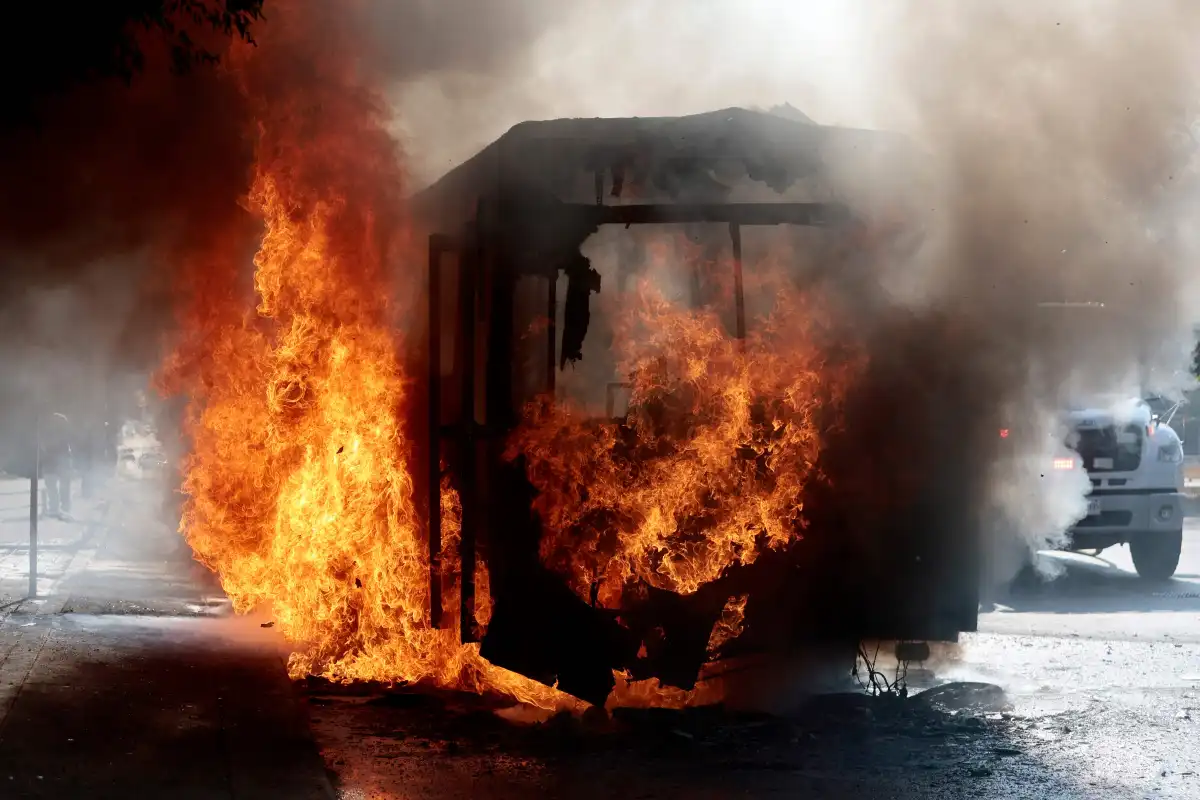
Mexico’s second largest metropolitan region was completely shut down after the capture and eventual death of top cartel boss Nemesio Oseguera Cervantes, El Mencho, at the hands of federal law enforcement. For two days, the people of Guadalajara and its surroundings were cut off from food, water and even medicine, as municipal authorities activated the “code red” public safety strategy to force the closure of all businesses and public services.
While most of the city’s 5 million residents who ventured outside during those 48 hours encountered little more than eerie desolation, the rest of the world was flooded with false accounts of violent drug gangs hunting down tourists and airports besieged by cartel operatives, that spread like a game of telephone via social media thanks to influencers and political streamers chasing clicks in the attention economy.
Reality on the ground wasn’t as dire, even though cartels are a major problem in certain parts of Mexico, and a contributing factor to insecurity in Guadalajara, specifically. However, Jalisco’s capital is as safe as any other large metropolitan area in the Western Hemisphere, and is actually an important hub of economic activity, with long-running ties to the American tech sector that date back to the 1960s, when Eastman Kodak opened its largest plant outside of the United States in Guadalajara to supply its entire Latin American market. The “Silicon Valley of Mexico” as it’s known, reported export revenue of $10 billion in the third quarter of 2025 alone.
Most of that is driven by U.S. demand, which also drives the demand for the far larger illegal narcotics market. El Mencho’s killing will have little effect in that regard and the multi-billion-dollar illicit drug enterprise is unlikely to suffer any major bottlenecks as the succession for the throne of his cartel, Jalisco Nueva Generación (CJNG) is completed. Considered the most powerful cartel operating in North America today, the CJNG is at the top of the DEA’s list of drug interdiction targets, and serves as one of the main justifications for the trillion-dollar drug war, that has never been about eliminating cartels or curbing drug addiction, as the facts clearly show.
Instead, it has always been a weapon for economic and political subversion wielded by the world’s only superpower to advance domestic and foreign policy objectives. Inside the United States, the carceral state maintains class and racial hierarchies by imprisoning poor, brown people for drug offenses, who are often victims of an inhumane health care system and driven to self-medicate. Outside of the imperial core, the drug war opens up avenues for economic warfare through the sanctions regime, that maintains first-mover advantages for American corporations and private enterprise more broadly by manipulating capital flows. This has been the case from the moment Nixon used it to enforce American suzerainty over the Panama Canal, all the way through to Trump’s extralegal kidnapping of Venezuelan president Nicolas Maduro in order to secure that nation’s oil.
Less dramatic, yet equally insidious examples of this dynamic abound. Just last summer, the Trump administration threatened to levy sanctions against three Mexican financial institutions, alleging that they were laundering money for drug cartels, and facilitating the purchase of chemicals for the production of Fentanyl. No proof was ever produced by the U.S. Treasury’s financial crimes division FinCEN, and an investigation by Mexican authorities failed to find any evidence, either. Nevertheless, the damage was done as the mere accusation eviscerated confidence and compromised their viability.
President Sheinbaum was forced to step in to avoid greater economic fallout, and inadvertently led her own people straight to a hornet’s nest of Trump-linked, libertarian crypto bros, by opening the door of Mexico’s banking system to an anti-regulatory cabal, that is chomping at the bit to tap large pools of public money to fund their enterprises, while gaining unfettered access to the financial and biometric data of millions of people across Mexico and Latin America. Much of this is being sold under the rubric of “financial inclusion”, and it doesn’t take a PhD in economics to know that the fastest and cheapest customer acquisition strategy in a country like Mexico runs through its systems of mass transportation.
—
Late last year, the state governor of Jalisco, Pablo Lemus, announced plans to increase public transit fares by more than 40% and unveiled a digital fare card, that would also provide access to dubious banking services and credit facilities. Enrollment in the “Tarjeta Única” is being incentivized with a sizable discount, reducing the fare increase to just 16% for card holders. The move sparked immediate backlash from citizens groups in Guadalajara, where the rate hike would pinch the wallets of more than 3 million daily commuters, who are already reeling from rising consumer prices caused by the erratic trade policies of the United States.
Opposition to the initiative centers mostly around the very rich terms of the deal between the state and Broxel, the Mexican “fintech” that is issuing the card and the suite of financial products. According to the governor himself, the company will charge a fee of MX$ 5.45 per card activation, plus a MX$ 4.45 monthly service fee for every user representing a potential annual windfall of MX$ 192 million (approximately US$ 12 million), that would come straight out of the state’s transportation budget.
Guadalajara’s digital bus fare cards are slated to begin operation just a few weeks from now on April 1st, although ongoing challenges from residents and some members of state congress could delay the rollout if not lead to the deal’s cancellation altogether. A federal tribunal recently granted a provisional suspension of the rate hike to 35 students, as part of a case that could set a national precedent and adjudicate questions surrounding the constitutionality of conditioning transit subsidies to the provision of personal data to a private company. Not to mention a private company known for shady business practices and mounting legal troubles, and links to one of Mexico’s biggest corruption scandals in recent memory.
But, stakes are high as the city prepares to host four World Cup games this summer. Not only is the international event projected to bring three million tourists to the city, almost all of which will certainly have to rely on public transportation during their stay, but a reversal in the courts could spell doom for a much larger, nation-wide fare card project led by another fintech, with ties to Mexico’s Secretary of Economy Marcelo Ebrard and a digital asset bank with direct links to Donald Trump and the U.S. Department of Commerce.
—
Arjun Sethi is a billionaire venture capitalist, who like many of his class cohorts, believes he has the right to decide what’s best when it comes to the public interest. For him, the notion that a government could demand a wealth tax is perceived as property confiscation and readily admits to hiding his money in cryptocurrency investments and other vehicles that are out of reach from tax collectors. “We’ll decide what’s fair.”, he recently posted on fellow billionaire Elon Musk’s site X, “We’ll decide what you get to keep.”
The Silicon Valley native and co-founder of Tribe Capital, has invested in over 100 companies during his short, but very active career. His VC portfolio includes companies like Snapchat, Lyft, and Opendoor, making him one of the most successful angel investors in the social media and emerging markets space. In 2021, Tribe Capital moved into the arena of digital assets with a multi-billion-dollar investment in the cryptocurrency exchange Kraken, and Sethi joined the company as co-CEO.
Kraken founder Jesse Powell is cut from the same ideological cloth as Sethi. A self-proclaimed Libertarian, Powell resents the government’s power to levy taxes, ardently believes in the inviolability of free markets, and is fully bought-in to the right-wing ‘woke mind virus’ conspiracy, which is designed to launder structural racism and blame minorities for the problems of the rich. Unsurprisingly, Powell is a big Trump supporter, and has been actively lobbying for anti-regulatory crypto policy for a long time. Just before the end of Trump’s first term, Kraken became the first cryptocurrency exchange to be granted a bank charter in the United States. The special purpose depository institution (SPDI) charter was awarded by the state of Wyoming, where far-right legislators have created a regulatory safe haven for the digital asset industry, including Trump’s own fraudulent crypto ventures.
During Trump’s 2024 run, Powell donated $1 million to his campaign and was quickly rewarded for his largesse by the suspension of a two-year FBI investigation into allegations of hacking and cyberstalking. Sethi, too, has pumped millions into Trump’s coffers to help grease the wheels of anti-regulation crypto policy and together with Powell, has made sure to provide absolute clarity about their ambitions during their repeated meetings with then candidate Trump, who has since delivered in spades.
In addition to the signing of important pieces of pro-crypto legislation like the GENIUS Act, which gave private corporations the ability to issue their own stablecoins – essentially, their own money in crypto –, Trump just awarded Kraken’s cryptocurrency bank a Federal Reserve master account. This is a historic move, that fundamentally changes the landscape of institutional finance, and opens the door for a full-fledged casino economy crawling with financial predators hawking highly speculative assets disguised as solid investments, and worse.
U.S. Secretary of Commerce and Epstein Island sightseer, Howard Lutnick, signaled the country’s commitment to the transformation last August, when he announced the first ever posting of official GDP data on the blockchain, aided by Kraken and a handful of other cryptocurrency companies. Lauded as the “cryptocurrency president”, Trump’s singular attention to this issue is almost out of character for a man known for his erratic behaviors, but also points to the broader implications of this policy shift, and reveals a more profound geopolitical reality.
In the same way Mexico’s government has a vested interest in fostering mechanisms of financial inclusion to grow its tax base, the United States has an almost existential need for the creation of a new financial system it can continue to control, as the world loses faith in the dollar as a reserve currency and America’s deficit spending model gradually implodes, with more and more countries shedding their T-bills. A multi-currency, blockchain-based system would allow a de facto roll-over of U.S. debt into a black hole of diversified digital assets that would be impossible to untangle.
Kraken and other cryptocurrency firms are giving the U.S. a way to diffuse the economic time bomb that was set off more than fifty years ago, when Richard Nixon took the dollar off gold and inaugurated the era of global capital flows. Half a century later, America’s national debt is all but un-payable and the military might that undergirded the dollar recycling system through the oil markets, is far less formidable than it once was. Trump’s childish diatribes against windmills are just a recognition of this reality and how the lifeblood of the American economy is careening towards its inexorable demise. But, people like Arjun Sethi and the rest of the billionaire tech lords, are offering to save the empire by controlling the monetization pipelines of the new oil: Data.
—
Following a $10,000 fine from Mexico’s financial regulator for continuing to operate as a fintech despite failing to meet the requirements of the country’s new fintech law, the agricultural credit lender run by René Saul Ferro and Eder Echeverría sought help north of the border, where most of the avocados they helped Mexican farmers sell ended up. Three funding rounds later, they modified their business model from rural financing to a full-on small-to-medium enterprise (SMEs) loan and credit services company. The Mexican startup secured almost $200 million over their A and B series rounds, along with the expertise of Arjun Sethi, who came on board as a co-founder of the concern, and was rebranded as Kapital.
By the end of 2023, Kapital dramatically expanded its potential marketshare in Mexico’s burgeoning fintech space, with the acquisition of Banco Autofin México (BAM) for the paltry sum of $50 million. Allegations of fraud, phantom charges and outright theft had followed the automobile financing corporation since inception, but the dozens of government contracts totaling hundreds of millions of dollars it received through its leasing division Arrendomóvil, should have made it far more valuable. Fortunately for Sethi’s new venture, a scuttled agreement with the Federal Electricity Commission to lease just over 8,000 electric line trucks, created the perfect opportunity to snatch it all up at bargain basement prices as the owners tried to cut their losses.
In a blog post published a few months before the acquisition, Sethi praised the Mexican fintech for its laser-focus on monetization and its positioning as a capitalization engine for the SME sector, lifeblood of Mexico’s economy. As Sethi himself points out, SMEs represent an oversized portion of the country’s economic activity and accounts for over 50% of employment in the formal (read taxable) economy. Crucially, SMEs are also at the heart of President Claudia Sheinbaum’s agenda, as laid out in her signature project, Plan Mexico, and which calls for the strengthening of SMEs through a series of policy initiatives and programs for financial inclusion.
However, Sheinbaum’s economic vision faces a serious, and perhaps insurmountable obstacle in the form of her own Secretary of Economy, Marcelo Ebrard Casaubón, whose long-held presidential ambitions have been frustrated for decades and who now finds himself in a position to impede the administration’s progress on this pivotal issue in order to set himself up for succession in 2030.
Ebrard’s political pedigree harkens to one of the darkest eras of Mexican politics, having risen from within the ranks of the Institutional Revolutionary Party (PRI) of Carlos Salinas de Gortari, and mentored by one of the latter’s closest allies Manuel Camacho Solís, who was himself in line to succeed Salinas de Gortari until Salinas shocked everyone by picking a different candidate from Sonora named Luis Donaldo Colosio, and set the stage for the implosion of Mexico’s ruling party.
—
Internecine warfare broke out among the PRI’s ranks as Camacho Solís refused to step aside and honor the unspoken party rule of unconditional support for the president’s choice, known as the dedázo (term of art for hand-picked), and prepared to run his own campaign. Just over a month later on January 1st, 1994, the Zapatista Army of National Liberation (EZLN) erupted on the national scene with their historic declaration and belligerent stance against the North American Free Trade Agreement (NAFTA), which was set to go into effect that very day. Salinas tapped Camacho Solís to negotiate a peace with the rebels in the Lacandon jungle, but warned him to drop his presidential ambitions.
Over the following months, a young Marcelo Ebrard helped his mentor maneuver the increasingly dangerous political minefield and conspired with Solís to strike a deal with Colosio, who was offered a smooth path to the presidency in exchange for the Department of the Interior, which Solís would use to execute a political reform program against the wishes of Salinas de Gortari. On March 23rd, 1994, Luis Donaldo Colosio was assassinated in cold blood as he delivered a stump speech in the border city of Tijuana, Baja California. His murder was pinned on the gunman, but never fully investigated. It was nevertheless clear to those in the know that Salinas himself had ordered the hit after discovering the plot to wrest control of the country’s political institutions and ruin his own backroom agreements with Colosio.
Colosio’s death was a watershed moment in Mexican politics, that led to the disintegration of the PRI’s dominance, and the unprecedented rise of a viable opposition. In the immediate aftermath, Camacho Solís abandoned the party, while his protege took cover in the fledgling Green Party. By 1998, the political winds were on the verge of blowing the PRI out of office for the first time in seven decades, and Camacho Solís came out of the shadows to establish the Center Democratic Party (PDC) with his loyal sidekick Marcelo Ebrard, and ran for president in the historic elections of 2000, only to lose to a former Coca-Cola executive by the name of Vicente Fox.
There has never been a more critical time to support independent media
RDMPRESS relies on your support to produce independent journalistic content. Please consider making a donation today.

Ebrard was PDC’s candidate to head up Mexico City’s government, then referred to as the Federal District, but couldn’t measure up to the charismatic, young populist from the state of Tabasco running against him for the rival Democratic Revolutionary Party (PRD), Andrés Manuel Lopez Obrador. The writing was on the wall, and both Camacho Solís and Marcelo Ebrard joined the PRD, with Ebrard incorporating himself into AMLO’s city government as an adviser. A political animal through and through, Ebrard worked his way up the ladder and managed to follow AMLO as head of Mexico City’s government in 2006, establishing himself as a serious candidate to compete for the PRD’s presidential nomination in 2012. But, once again, he was passed over in favor of AMLO who topped the party’s ticket that year in an election that returned the PRI to power, and threatened to upend all the progress made by Mexico’s opposition parties over the previous decade.
Enrique Peña Nieto’s presidency spelled doom for Ebrard, who became a direct target of the PRI’s revenge tour and was forced to flee the country over fear of imprisonment. The old guard’s bid to restore what used to be known as the perfect dictatorship, failed to gain momentum in a country that had no desire to return to those bitter times. Meanwhile, AMLO began building a new political coalition to bring the left and center left under one roof. The Movement for National Regeneration (MORENA) was born in the midst of Peña Nieto’s disastrous administration, whose corruption only served to strengthen the new party and led to a landslide victory for AMLO in 2018.
Ebrard came back to Mexico and was handed the Department of State by AMLO, who signaled his intention to anoint him as his successor for 2025. But, history has a funny way of coming back around, and much like Salinas de Gortari’s game of bluff with Ebrard’s old mentor Solís, AMLO played his cards close to the chest. In Ebrard’s mind, he was next on the pecking order and due for his reward, but the president had other ideas for MORENA’s future. His protege, Claudia Sheinbaum was sworn in as Mexico City governor in 2018 as well, taking her place alongside Camacho Solís, AMLO, and Ebrard himself in the pantheon of city leaders.
As governor of Mexico City, Sheinbaum was confronted with the lingering consequences of Ebrard’s corrupt mismanagement of city resources, which had saddled the urban administration with a 15-year, billion-dollar debt, as a result of a scandalous procurement contract for 30 new subway cars that he commissioned at more than twice the cost, and diverted the difference to cronies through a brass plate company during his tenure. To make matters worse, the subway expansion project those cars were slated for, collapsed three years into Sheinbaum’s government, resulting in the tragic death of 26 people and dozens of serious injuries. Needless to say, there is a lack of trust between the two, that poses a problem for Ebrard’s as of yet unfulfilled presidential ambitions.
—
State of Mexico representative Daniel Sibaja González grilled the Secretary of Social Development, Alejandra del Moral, over allegations that her agency (SEDESOL), was employing Broxel Financial to distribute funds for social development projects, despite the company’s involvement in helping the disgraced former governor of Veracruz Javier Duarte, siphon millions of dollars away from the state treasury through a number of shell companies as part of the “Master Swindle”. Broxel was identified in the Panama Papers as one of the sofipos Duarte used to fleece Mexican taxpayers through 128 shell companies, whose money ended up parked in 41 real estate properties across the United States and other assets.

Soon after winning reelection to the local congressional seat in 2021, Sibaja distinguished himself as a young firebrand, who appeared committed to fighting corruption and wasteful government spending. His relentless questioning of del Moral almost a year later reflected that, and showed no regard for his own party affiliations as a representative for MORENA, given that the program he was attacking was a flagship project of MORENA’s social initiatives, called Salario Rosa, which was intended to provide a stipend to homemakers in order to support women outside of the workplace. Sibaja nevertheless maintained an aligned position with the party through his calls for frugality by public servants, which was also very on brand with AMLO’s messaging, in particular. He even sponsored an austerity bill and constantly railed against the excesses and extravagant lifestyles of government officials whenever he got a chance.
All that indignant bluster suddenly disappeared late in 2023, when polls began to show a decided advantage for Claudia Sheinbaum in the lead up to the 2024 presidential election. Before then, Sibaja had gone after Sheinbaum herself, berating her campaign for spending too much money on billboards plastered all across the country, although his mask soon dropped once it became clear that not only was she garnering more popular support, but AMLO himself was backing her candidacy. It all turned out to be a ruse designed to propel his political benefactor to the top of MORENA’s ticket,
During the summer of 2021, Marcelo Ebrard held a private gathering in the State of Mexico with members of MORENA’s coalition to announce his intention to seek the presidency in 2024. Sibaja, who has strong ties to the then party chairman Mario Delgado, was among those present. It was at this meeting where Ebrard recruited Sibaja to lead an internal campaign to garner support for his candidacy among representatives as preparation for the campaign. In 2022, Sibaja organized a national symposium for MORENA representatives in Jalisco, where Ebrard would be the guest of honor. As the race heated up in early 2023, Sibaja went on the offensive on social media, describing Sheinbaum’s campaign as a farce, while Ebrard played the victim card over his role in the subway line tragedy.
In the end, it was all for naught and Ebrard had no choice but to concede MORENA’s stage to Sheinbaum, who went on to win the election by an historic margin. For his efforts, Sibaja was rewarded with the top post in the State of Mexico’s department of Mobility (Semov), overseeing all transportation policies and projects in the entity. Almost from one day to the next, Sibaja’s first act as a local representative was revealed to be just that, an act. His tirades against wastefulness in government, the righteous indignation over Broxel’s involvement in redistribution programs, and even his appeals to the frugal habits of state bureaucrats. All of it was a calculated performance that was no longer necessary, and was soon splurging on a lavish $300,000 wedding celebration, complete with customized Yeti thermoses for each of his 500 guests, and a bespoke dance floor hand-painted for the occasion.
Sibaja was unfazed by the press coverage, which crucified him for the hypocrisy. But, that was hardly the worst of it. At Semov, the vast majority of the region’s public transportation providers accused him of stonewalling, delaying concession renewals, and impeding their ability to comply with regulatory frameworks. He was described as a racist and a classist by concessioners, who couldn’t get the agency to do anything on their behalf. At the same time, Sibaja’s negligence resulted in the tragic death of three people whose pick up truck fell into a ditch as they tried to avoid a sinkhole that had been reported to Semov more than a month earlier and never fixed. In May 2025, Daniel Sibaja revealed the true motivation behind his inept management, as well as his repeated attacks on Broxel, with the launch of Movimex, a digital fare card for the State of Mexico’s transit system that competes directly with Broxel.
Addressing members of the media gathered at the Poliforum Siqueiros in May 2025, Sibaja decried the fact that only 20% of public transport vehicles in the greater metropolitan area of Mexico City were “regularized”, though he failed to acknowledge his central role in creating that reality by refusing to process applications and causing delays for concessioners. “This is the beginning of the transformation”, he declared before outlining the nature of the partnership, which in addition to the fare card, includes replacing the transport vehicles currently on the road through a financing scheme that the government will provide concessioners, as well as the creation of a centralized transit monitoring and surveillance system.
Like Guadalajara’s Tarjeta Única issued by Broxel, Movimex doubles as a debit card and a kiosk for financial products through an app. In contrast to Broxel, the issuer is an actual bank called Banco Dondé, with backing from IPAB, Mexico’s version of the FDIC, to provide protections for depositors. Access to financial services will be provided by Stori, a sofipo that is licensed by the state to offer instant micro loans with interest rates that are at the discretion of the company, since Mexico has no laws regarding usury. Broxel, for instance charges 97% interest on their micro credit products, offered to unsuspecting Mexico City subway riders through the system’s Broxel fare card.
Rounding out the partners on the Movimex deal is none other than Arjun Sethi’s Kapital Bank, which thanks to its acquisition of embattled car loan company, Banco Autofin, will be doing business directly with Daniel Sibaja to expand their market share across Mexico. This past January, the bespectacled newlywed submitted his resignation from Semov in order to assume the leadership of the Mexican Association of Mobility Authorities (AMAM), where he will preside over transport policy for the whole country.
—
Standing in the middle of the stage for the photo op, wearing another iteration of the blue suit jacket he was sporting at his protege’s opulent nuptials a year before, was Marcelo Ebrard, who was scheduled to meet with U.S. Secretary of Commerce Howard Lutnick and other administration officials the next day. Obliged to travel to Washington D.C. every ten days, on average, to deal with Trump’s erratic trade polices, Ebrard had managed to negotiate more lenient terms and avoid tariffs on most goods, with promises to scale-down China’s nearshoring operations in Mexico, especially those related to the auto industry and technology.
Despite Mexico’s willingness to assuage America’s biggest concerns, Trump continued his aggressive posturing, and just two months later issued the sanctions threat against CiBanco, Vector, and Intercam. Three private Mexican financial institutions accused of money laundering and the facilitation of Fentanyl production on behalf of the CJNG drug cartel. The move by the U.S. Treasury came days after the G-7 summit in Canada, which Trump exited abruptly to avoid signing a statement being drafted by the world’s leading economic powers calling for de-escalation between Israel and Iran, that in hindsight reveals a deliberate method to the madness.
America’s unfounded claims against the Mexican finance companies, which all together barely comprised less than 1% of the nation’s financial activity, resulted in the immediate downgrade of their credit rating by Fitch’s, which in turn caused their stock to crash and produced an irreversible crisis of investor confidence. Between them, they also administered four public pension funds worth approximately $16.5 million, whose beneficiaries were suddenly left in the lurch by the actions of the Trump administration, which followed through with the sanctions in October, and forced Sheinbaum’s government to intervene, despite presenting no proof to Mexican authorities.

By late 2025, most of these companies’ assets were acquired by competitors, with CiBanco going to Guadalajara-based stock exchange, Grupo Multiva, which is itself owned by media, healthcare, and finance conglomerate Grupo Vazol. Vector was absorbed by Finamex stock exchange. Most of Intercam’s operations, including a stock exchange, a bank specializing in nearshoring, and the pension fund management division were all acquired by Kapital Bank, which in turn became a full-fledged financial holding company under Mexican statutes, and is now authorized to hold commercial deposits, underwrite loans, and engage in speculative stock trading. Meanwhile, Intercam’s advisory and securities divisions were bought by $65 billion-a-year global financial services firm StoneX, to grow its $18 billion Latin American wealth management portfolio, and named Intercam’s own Everardo Vidaurri to head up their international securities division in Miami.
At the end of the day, Trump’s bully tactics and drug war propaganda only led to further consolidation of the financial industry. No fentanyl pipelines were affected and whatever money laundering was happening through these targeted companies, if any at all, is now simply taking place elsewhere. And crucially, Trump’s actions helped his good friend Arjun Sethi establish a foothold in the Mexican banking industry. With Kapital Bank’s new status as a Financial Group, the company can exert far greater influence over the Mexican economy, and has taken an important step in growing its presence in other Latin American countries, where it is already active.
Shortly before the U.S. Treasury signaled its punitive action against Intercam and others, Arjun Sethi revealed that his cryptocurrency exchange and digital asset bank Kraken would move its global headquarters to Wyoming, where a right wing-dominated legislature has built the most unregulated legal environment for crypto in the entire country. Since then, Trump’s all-out push for crypto has only strengthened Sethi’s support for the President, and in January announced that Kraken would sponsor the controversial Trump Accounts for every newborn in the state, qualifying it as an “investment in Wyoming’s future”, and making it clear that it was “not a gift”.
Beyond a transparent effort to remove any implications of a bribe from the sponsorship, Sethi’s justification of this “investment” points to his ideological opposition to government funded programs, and underscores the desire he and his fellow billionaires have to destroy the social safety net, and subsuming its vital function in society to the whims of the market, so that they can decide what part of their obscene profits we get to keep. For someone like Sethi, Mexico’s largely unregulated and lightly enforced financial landscape is a goldmine. But, the country’s lax supervision over citizens’ personal data opens the door to an even larger treasure.
—
Broxel’s disastrous implementation of Mexico City subway card from 2017 to 2019 was quietly jettisoned by Sheinbaum’s city government as complaints piled up. Among the first attempts at financial inclusion through digital payment systems in the country, the card was plagued with problems from the start and pushed dubious financial products through its app, and even a multi-level marketing scam, that tried to recruit app users to sell typical MLM products like cosmetics and supplements through Broxel websites.
In spite of these abuses and allegations of colluding with MORENA’s opposition to buy votes through the company’s voucher programs and actually flouting Mexico’s anti-money laundering laws, Claudia Sheinbaum continued to furnish the fintech with lucrative government contracts as late as 2023. Now, the company is poised to take over Guadalajara’s bus fare system and try their brand of “financial inclusion” on another part of the country if the opposition to their plan doesn’t prosper.
While the residents of Jalisco’s state capital have plenty of good reasons to fight the rollout of Broxel’s fare card, it’s not out of the realm of possibility to think that some of the pushback could be astroturfed by the interests behind Ebrard’s competing fare card, Movimex. Especially since the champion of that private-public partnership in the State of Mexico’s congress, Daniel Sibaja, is about to assume control of the national mobility agenda. Either way, Arjun Sethi and his clan of MAGA-loving crypto bro billionaires are set to benefit.
One of the least scrutinized aspects of Guadalajara’s Tarjeta Única is the biometric component. Should the rollout proceed this spring, commuters who want get the 24% discount on the new fare will be required to submit to an iris scan, digital fingerprinting, and facial recognition software. In addition, card holders have to accept terms of service that include access to their voice patterns, geolocation, and other “relevant profiling data”. Metamap, the San Francisco-based company that will manage all customer data, was a Tribe Capital venture and Sethi himself sat on its board. In fact, he was the only board member, and for all we know, might still be.
Metamap was acquired by another Silicon Valley company called Incode, in 2024. Although the founder and CEO happens to be Mexican, the Softbank-incubated, AI-first identity verification company is still governed by U.S. law and as such, is bound by statutes that compel private corporations to share customer data, including biometric data, with federal and state law enforcement agencies if a warrant has been issued, and completely bypasses Mexico’s own data privacy protection laws simply by existing on the company’s servers. Not even the already gutted USMCA trade agreement has any cross-border contingencies. And in light of the current political climate, both in the United States and Mexico, it’s not too far fetched to consider a reality where the biometric, financial and location data of millions of Mexican citizens, who live 1,500 miles from the U.S. Mexico border, could end up in an ICE database because they take the bus to work.
Cover photo: Burning public transportation vehicle in Puerto Vallarta, Jalisco. The bus was set on fire by elements of the Cartel de Jalisco Nueva Generación to create roadblocks after the capture of their leader, Nemesio Oseguera Cervantes, alias El Mencho. Feb. 22, 2026