
A Feast of Pigs
Marco Rubio and the Cuban-Americans
Part I
No one outside the family knew who the guajiro in the dark blazer was. To the countless onlookers behind the steel barricades and over 230 members of the media gathered in the hotel courtyard for the momentous outcome of the 2010 midterm elections, the portly gentleman sitting two chairs away from Florida’s former governor, was just another VIP guest waiting for the man of the hour to appear at the podium.
Orlando Cicilia Jr. was not merely an ex-convict. He’d been one of the prime suspects of Operation Cobra; part of a ten-year joint investigation by Miami PD, the FBI, the Bureau of Alcohol, Tobacco and Firearms, and U.S. Customs, that dismantled a major narcotics ring operated out of a jewelry store in Little Havana and an exotic pet shop, from where Cicilia handled the sale and distribution of millions of dollars-worth of cocaine and marijuana for buyers all over the country.
By the time federal prosecutors brought their case against him and a dozen other defendants to a Miami courthouse in 1988, he had been married to the bleach blonde woman seated next to him for almost a decade. A devoted wife, Barbara Rubio was prepared to wait all 35 years of her husband’s prison term, if necessary. Pregnant with their second child when he was arrested, she moved in to her parents’ garage in West Miami after U.S. Marshals seized their home in lieu of Cicilia’s missing $15 million drug trafficking fortune.
Authorities never found the money, and his early release after serving less than a third of his sentence in a low-security detention facility, would later raise questions about his unique connection to one of the rising stars of the Republican Party. But on this particular evening, Cicilia’s past and his relationship to the newly-elected U.S. Senator from Florida was still a closely guarded secret.
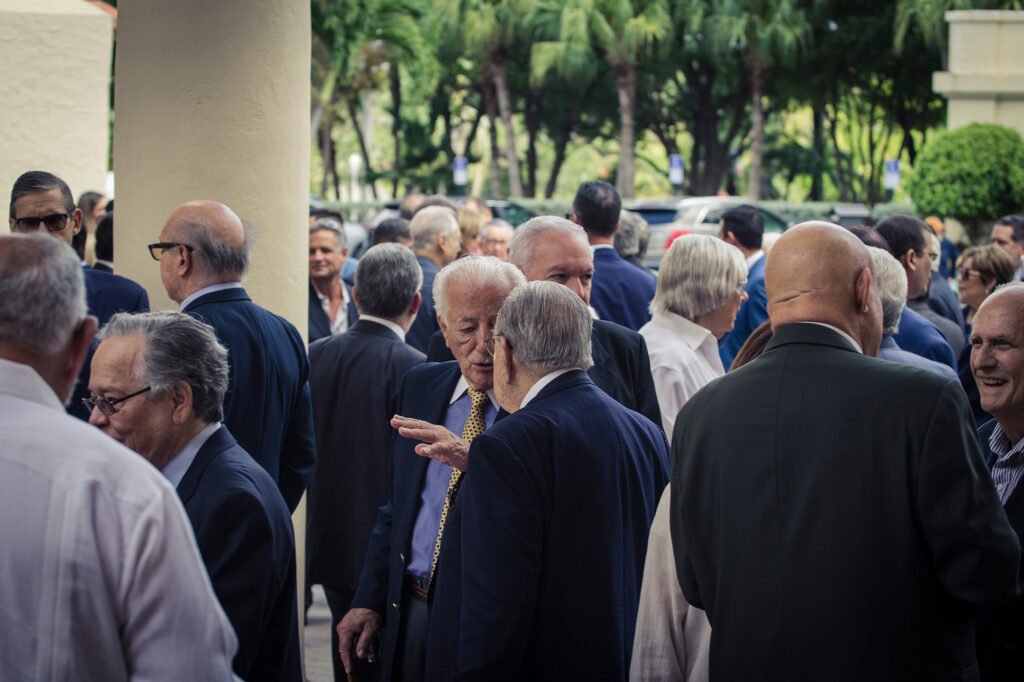
His brother-in-law, Marco, stepped onto the makeshift stage at the Biltmore hotel accompanied by his wife and children under a rain of confetti. Fashioned by the same architect who designed Havana’s National Hotel, the venue is a mainstay for local Cuban elites, where every year survivors of the Bay of Pigs invasion convene to commemorate the anniversary of their defeat in a lavishly catered affair that is religiously attended by the Cuban-American political brass. A perfect setting for Rubio’s hackneyed appeals to American exceptionalism and the speech’s emotional payoff, when he proclaimed that he would “always be the son of Cuban exiles”.
A calculated remark meant to elicit the loudest cheers of the night and play up his victory for those who had disproven the claim, with immigration records and other documents that showed his family had left the island well before the Cuban Revolution. Despite the revelations, Rubio doubled down on the Cuban-American identity and its pact with U.S. empire. Because, fundamentally, to be a Cuban-American means conforming to the hegemonic designs of the United States, and denying the struggle of those within its sphere of influence to shake free from the yoke of imperialist aggression.
Better to say that your parents had fled Castro and not the scant economic opportunities offered by the U.S.-backed dictatorship of Fulgencio Batista, who answered only to sugar barons, mafia bosses and the capital interests of the United Fruit Company. Fifteen years after that euphoric night in Coral Gables, Marco Rubio would inherit the post that long-time legal counsel for United Fruit John Foster Dulles held, when he began inflicting maximum economic pain on the Cuban people in the 1960s, forcing tens of thousands to seek asylum in the United States, with the help of his brother Allen Dulles – one time president of the famous banana concern –, who was coordinating regime change operations in Cuba from CIA headquarters.
As Secretary of State, Rubio now leads the charge of U.S. interventionism, under the guise of a new drug war as Trump’s ICE goons round up immigrants across the country and American warships target motorboats off the coast of Venezuela. But, his meteoric rise from municipal politics to the U.S. State Department in the span of just twenty-five years cannot be understood without the likes of Orlando Cicilia, whose scandalous criminal history was actually linked to a secret CIA program that employed Bay of Pigs veterans to traffic narcotics on behalf of the agency for the economic and political subversion of Latin America.
Birds of An Exotic Feather
Mario Soloman Tabraue was cocky son of a bitch. He would openly brag about his illicit enterprise in telephone conversations, and often answered calls as “Mario Tabraue, drug dealer” just to toy with investigators listening in over his tapped phone lines. A real-life Tony Montana, who owned panthers, lions, and monkeys, among other exotic creatures in his sprawling South Dade ranch. An inveterate animal lover and cold-blooded killer, Tabraue’s confidence wasn’t innate in the conventional sense, even though his father played a crucial role in his seemingly magical ability to skirt the law.
Orlando Cicilia started working for Tabraue in 1983, just after the drug king pin had spent a season in New Jersey waiting for the heat from his botched criminal trial to cool off. Miami’s Organized Crime Bureau (OCB) had come down hard on Tabraue’s operation a couple of years earlier and raided his South Dade property after a five-month investigation tying him to the murder of an undercover agent of the Bureau of Alcohol, Tobacco and Firearms, named Larry Nash. Armed Metro officers stormed Tabraue’s animal farm and seized 13,000 pounds of cocaine, pot, and quaaludes. A total of fourteen people were taken into custody, including a former U.S. Attorney, who was alleged to have been an adviser to Tabraue’s narcotic ring, proffering tips on how to game the system and recover confiscated merchandise.
The case went to trial about a year and half later, but before prosecutors could call their first witness, Circuit Court Judge Theodore Mastos put the kibosh on County litigators. Citing two violations of State wiretap laws, Mastos threw out all of the prosecution’s key evidence and left them no choice but to drop the charges and hope for an appeal by the Dade Attorney’s Office, then led by future United States Attorney General Janet Reno. She declined to file an appeal and all but one of the defendants were set free.
Within a few months, Mario was back in business and bigger than ever. By the summer of 1982, he’d set up an exotic pet shop in Coconut Grove called Pets Unlimited, less than a mile away from a giant warehouse he purchased to keep his massive inventory of wild animals and marijuana. Most of the cocaine was kept in Orlando Cicilia’s brand new 3-bed, 2-bath country house, that featured a barn and four stables. As Tabraue’s frontman, 27-year-old Cicilia would use the pet shop as an office to arrange drug sales from coast to coast, and provide his young wife with a life her parents never dreamed of.
In his autobiography, Marco Rubio describes Christmas Eve of 1983 as his “fondest childhood memory”, and paints a scene of warm reconciliation between his mother and eldest sister, who had refused to move to Las Vegas with the rest of the family a few years earlier and stayed behind to marry her high school sweetheart. The Rubios had returned to spend the holidays at the Cicilia’s new home that winter, but nowhere in the story he tells in An American Son, is how a pair of twenty-somethings with nothing but a high school education, like Barbara and Orlando, could afford such luxury.
Dade County mortgage records offer a small glimpse into the reality underlying Cicilia’s newfound prosperity. The house, worth about a half-million dollars in today’s market, was sold to the young couple by the Cuban manager of a Colombian cargo airline, known to smuggle arms and cocaine into the United States, with a mortgage underwritten by a South Florida subsidiary of First National Bank of Boston, which was two years away from a $1 billion money-laundering scandal linked to organized crime stretching from New England to Miami.
Twelve-year-old Marco was oblivious to the colossal web of drug traffickers, double agents, mercenaries, and mobsters that lurked around his brother-in-law, and he was only too happy to see Orlando again, whom he thought of as an actual brother. Young Marco laughed as Cicilia chased his little sister, Veronica, with the severed head of the roasted pig they were about to feast on for nochebuena, unaware that he was also being stalked by fate as the invisible tentacles reaching all the way to the White House and deep into the darkest recesses of the American national security state, were moving closer to mark his destiny.
Geopolitical High
Omar Torrijos’ refusal to acquiesce to U.S. demands in the renegotiation of the Panama Canal Treaty unleashed President Nixon’s ire and sparked a plot to remove him from power. The Panamanian leader had rebuffed Washington’s bid to secure exclusive construction rights in the Canal Zone and a 50-year military presence in his country, further complicating a rapidly deteriorating geopolitical reality for the United States, which was struggling to maintain the dollar’s hegemony and was looking down the business end of a major energy crisis. Already disliked for his Communist sympathies, getting rid of Torrijos wouldn’t require much justification and plans to fabricate a public rift between him and his chief of intelligence and CIA asset, Manuel Noriega, were discussed by Nixon aids John Ehrlichman and Egil Krogh.
The spat would serve as an excuse to neutralize Torrijos and advance American aims by framing the disagreement in the media over Canal policy and drug trafficking, tied to the Santo Trafficante network. Bureau of Narcotics and Dangerous Drugs (BNDD) director John Ingersoll was brought in to hash out a proposal they could bring to the president, but Nixon ultimately decided to call on the expertise of retired CIA officer E. Howard Hunt to carry out the extra-judicial killing directly, without all the fuss. Ironically, just as Hunt’s crack team of sicarios were in Mexico ready to pounce, the Watergate scandal broke in the press and the operation was aborted.
CIA director Richard Helms subsequently approached Ingersoll with another idea to merge BNDD’s anti-narcotics mission with the President’s political objectives. As the White House went into full damage control over the break-in at the DNC headquarters, Helms laid out the concept of creating a sub rosa agency inside Ingersoll’s BNDD that would operate on two levels and separate chains of command. One would stick to the Bureau’s counter-drug mission by developing “long-range strategic intelligence” to kill, kidnap or otherwise “neutralize” drug traffickers throughout the Caribbean and South America, while another would target senior foreign officials to advance Nixon’s political agenda. Fascinated by the cloak-and-dagger undertaking, Ingersoll agreed and the Bureau of Narcotics Covert Intelligence Network (BUNCIN) was born.
BUNCIN was to be based out of Miami, where scores of CIA-trained Bay of Pigs veterans would be recruited to fill the ranks of the secret channel. Many were serving time for trafficking drugs under the auspices of the CIA following their capture in the DOJ’s Operation Eagle, the largest federal narcotics enforcement operation ever up to that point, and another example of the conflicts of interest that plagued the national security state. Bay of Pigs vet Roberto “Bob” Medell, who had run counterinsurgency ops for the agency in the African Congo and was the principal agent of Manuel Noriega’s CIA case officer, was brought on to lead BUNCIN’s anti-narcotics division. He would, in turn, handpick fellow Bay of Pigs militant Guillermo Tabraue Sr. to be his principal agent on the ground in Miami.
There has never been a more critical time to support independent media
RDMPRESS relies on your support to produce independent journalistic content. Please consider making a donation today.
Tabraue Sr. was considered a pillar of the community, and few suspected that his jewelry shop on West Flagler street was a clearing house for a multi-million-dollar narcotics operation. Mario Tabraue’s father commanded a $1,400 weekly salary from the CIA due to his extensive reach into Miami’s underworld, which in addition to drug trafficking circles, also included connections to the construction industry and illegal gambling rackets taking place all over the city. From his unassuming jewelry store in Little Havana, Tabraue Sr. entertained the business of Miami PD’s finest, who regularly patronized the establishment to drop off information or pick up the occasional bribe, while he laundered proceeds of a large-scale narcotics ring operated by José Medardo Alvero-Cruz, a.k.a. El Padrino.
As the Watergate coverup began to unravel, Nixon dissolved the BNDD and created the Drug Enforcement Agency (DEA) to bolster his law-and-order image by declaring the infamous “war on drugs”. BUNCIN was renamed to the DEA Clandestine Operations Network or DEACON 1, and all of its covert assets were moved to the new agency. Medell was replaced by national intelligence officer Gary Mattocks, who continued running Tabraue Sr., and his network of informants. After Nixon’s resignation in 1974, DEACON 1 was terminated following violent incidents by rogue anti-Castro assets, who had started to wreak havoc in the streets of Miami.
DEACON’s unemployed Bay of Pigs veterans splintered. Some began forming independent terrorist cells to pursue their own dreams of regime change in Havana, while others were reintegrated into new covert operations across Latin America under the new DCI, George H.W. Bush, and the growing neoconservative faction in Washington. Miami was rapidly descending into complete bedlam as more and more coke money flooded the city, seeping into every nook and canny of its economic life. Cops, bankers, politicians, real estate developers, and even a few priests were in on the take. It was a boom town with the sound effects to go with it, as dynamite explosions and bullet-ridden storefronts went hand in hand with suburban sprawl and construction of beachfront condominiums.
Amidst the chaos, a failed politician from New Jersey found his second wind in South Florida. The flood of Cuban refugees that arrived during the Mariel boatlift, compounded by the Central American diasporas created by U.S. interventionist policies and counterinsurgency operations across the region, had changed the once Democratic stronghold into a cauldron of reactionary conservatism, that the Cuban-born, east-coast transplant would exploit to rise in the ranks of Florida’s Republican Party and become one of its top fund-raisers and insiders.
The Kingmaker
Al Cardenas came close to ruining his career after nearly killing a man on a bicycle during a hit-and-run. Charged with resisting arrest and leaving the scene of an accident, the young lawyer had also registered a .06 alcohol-blood level on the breathalyzer. Luckily for Cardenas, the victim survived after weeks in intensive care and the judge gave the budding Republican operative a slap on the wrist, sentencing him to one year probation, with a requirement to study the deleterious effects of driving under the influence.
It was a low point for Cardenas, but dignity wasn’t a quality prized in his milieu. The Havana native was not above playing dirty to get his way, as evidenced by his short-lived success in New Jersey municipal politics, where he engaged in questionable tactics to get himself elected to the chairmanship of a local Republican Executive Committee for all of one month in 1974. His pyrrhic victory was part of a last ditch effort by the state’s Republican political machinery to hold onto power in the only Republican county of New Jersey in the wake of the Watergate scandal.
A couple of years after his ignominious exit from the Garden State, Cardenas re-emerged in Miami, as chairman of Dade County’s Republican Party, where he faced questions about malicious propaganda emanating from Gerald Ford’s campaign offices in Little Havana during the 1976 presidential race, purporting to show a letter addressed to Jimmy Carter from Fidel Castro, praising the Democratic candidate and sowing hostility towards the peanut farmer in the Cuban exile community. Cardenas denied any involvement, and Alberto Rodriguez, the editor of the anti-Castro weekly Patria that had published the fake screed, was forced to clarify that the ‘letter’ was satire.
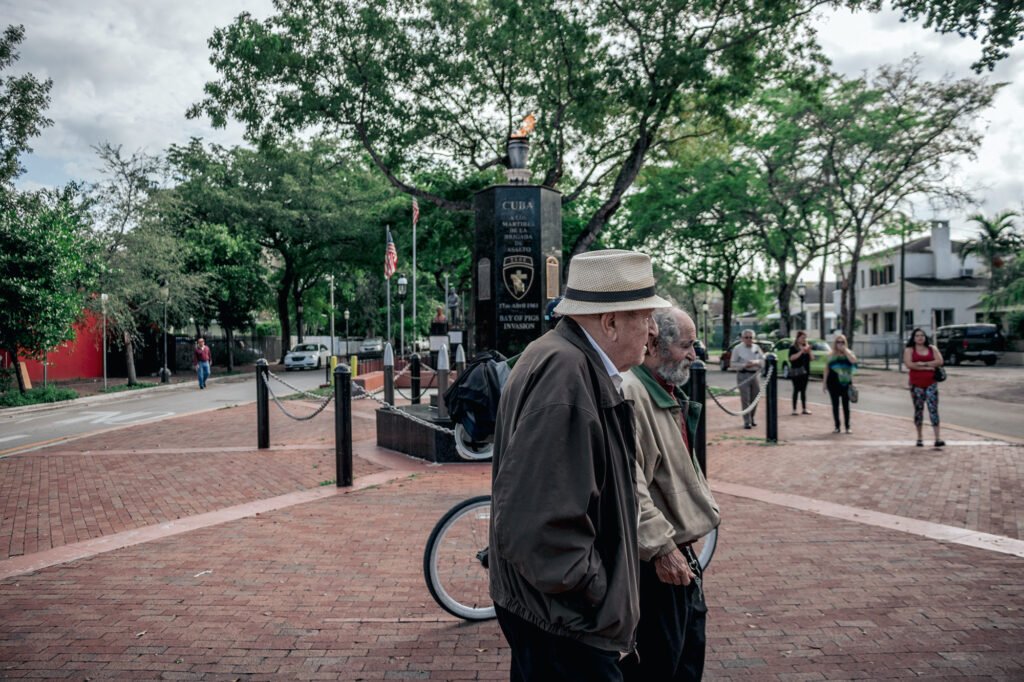
Originally published by a New Jersey-based, CIA-funded anti-Castro paper called Avance, the letter had no impact on the race whatsoever, as Carter carried Dade County like every other Democrat had done before him. But, Cardenas was working hard to change that dynamic and took every opportunity to make the anti-Castro messaging an integral part of the Republican platform. Miami’s Cuban population was growing steadily, and soon enough would eclipse all other demographics in the city.
Just two months after completing his year-long probation for fleeing the scene of an accident, Al Cardenas joined Ronald Reagan’s transition team in November, 1980, and began his climb to the pinnacle of Florida’s Republican Party. By the end of Reagan’s first term, Cardenas had forged important alliances across the state and was poised to deliver the once Democratic stronghold to conservatives by forming an alliance between Miami’s Cuban reactionaries and the Evangelical Christian faction led by televangelist Pat Robertson.
Cardenas was feted by then Chairman of Florida’s Republican Party and future governor, ‘Jeb’ Bush, cementing his place among the Party’s movers and shakers as the Bush dynasty rose to prominence with the election of George H.W. Bush. The lawyer regularly mixed politics with his legal practice, representing clients like McDonald’s and big developers in court and greasing the wheels of power behind the scenes by offering to raise money for candidates in exchange for votes he might need. By the early 1990’s, Cardenas was a force to be reckoned with in South Florida politics, and as the Iron Curtain came down, he was in a position to further fan the dying flames of anti-communist rhetoric in order to maintain the base of reactionary conservatism that buttressed the Republican’s newly-won control of the State.
During Bob Dole’s failed presidential run in 1996, Al Cardenas met an ambitious UM law school grad at the candidate’s campaign offices in Little Havana. Marco Rubio had just completed his Juris Doctor degree at the prestigious University of Miami, and was $150,000 in debt. All set to begin an internship at the Miami-Dade office of the State Attorney after the election, Rubio took the job Cardenas offered him at his law firm instead, and celebrated with his close friend and CIA propagandist, David Rivera, who had originally tapped him to lead Dole’s campaign in Dade and Monroe Counties. Rubio’s political career wouldn’t officially begin until three years later, when he won a seat on the city commission of West Miami. But, it was already clear to Cardenas that the young Cuban-American wasn’t afraid of the mud.
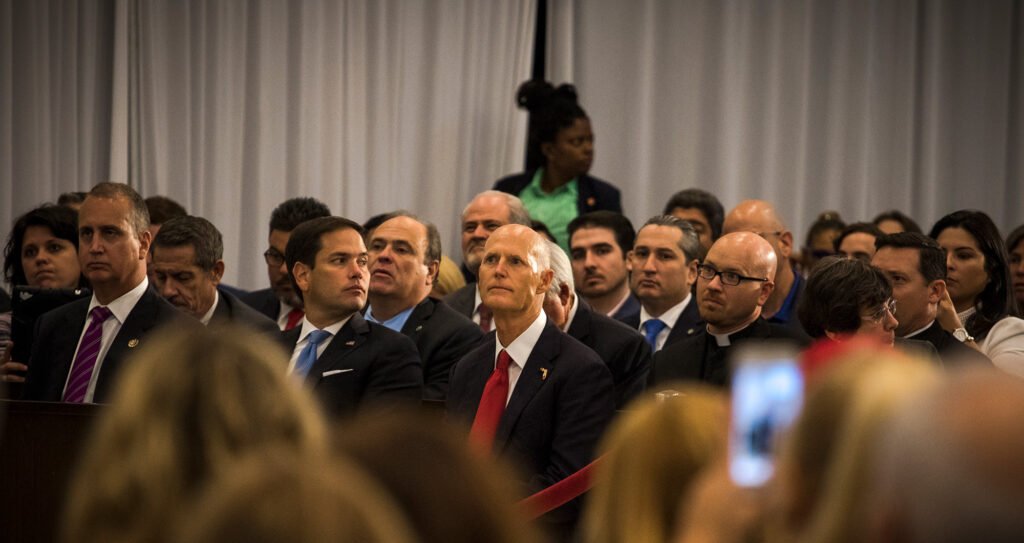
Cover Photo: Miami, Florida, June 17, 2017 – Sen.(R) Marco Rubio walks towards the podium on the stage of the Manuel Artime Theater in Little Havana during a visit by President Donald J. Trump to announce a revised policy on Cuba, reversing steps taken by former President Barack Obama to normalize relations with the Caribbean nation. In the background, veterans of the CIA-trained Brigada 2506 and their relatives applaud. | Photo Credit – Raul Diego Medina for RDMPRESS. All Rights Reserved.